
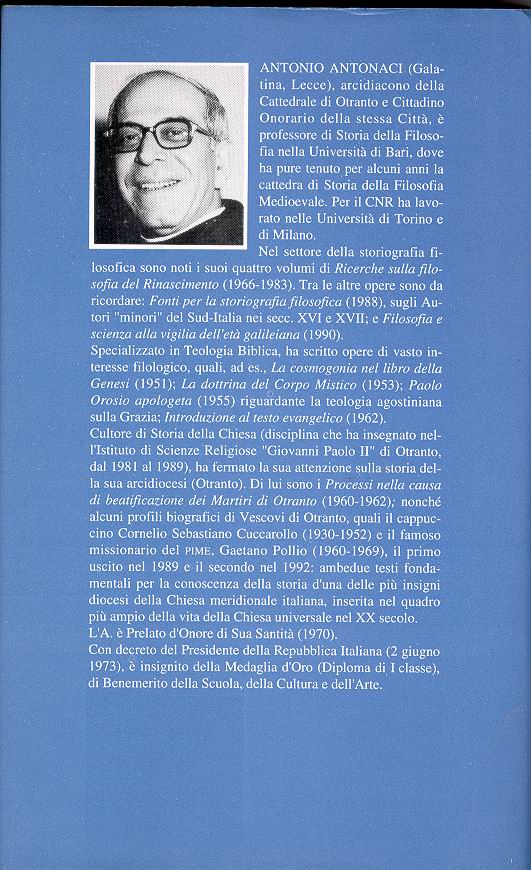
Mgr Antonio Antonaci
Ed. PANICO
Printed in the month of December 1993
At the printing works of Grafiche Panico
73013 Galatina (Lecce)
Italy
S.S. 476 Km. 18,600
Tel. and Fax 0836/569421
Extracts from the above book /
Monsignor Accogli comes from Salento, the southernmost tip of Italy, where Our Lady of Leuca, who is called "de finibus Terrae" (at the ends of the Earth), reigns sovereign over the entire Terra d'Otranto. Furthermore, in his native Andrano, under the shadow of Our Lady of Grace—better known among the people under the title "of Graces"—Accogli drank in devotion to Mary with his mother's milk. On the other hand, if one were to draw up a biographical profile of the great priestly figures of yesterday and today in the Terra d'Otranto, one would find that, in one way or another, the Virgin Mary has always been the One who guided the souls of so many priests in all the different forms of apostolate.
And now that Nuncio Accogli has returned within the walls of his native land, his thoughts are always turned toward Our Lady. Suffice it to think of how and how much he is spreading devotion in his Diocese of Otranto to the Virgin of Soufanieh (Damascus)—she who is called, even by Muslims, the "Lourdes of the East." His journey along the roads of the world, along the most disparate itineraries, has always found, at every corner, the maternal face of Mary. From Our Lady of Attàrico in Andrano to Our Lady of the Martyrs in the seminary of Otranto, to "Regina Apuliae" in the seminary of Molfetta, to Our Lady of Confidence in the Lateran seminary in Rome, to the "Legion of Mary" in Formosa, to Our Lady of Damascus, it is an entire constellation that has given spiritual breath and great comfort to this man who, today, even framed by white hair, displays the inner freshness of a heart full of hope and projected into God's future. It is always true that, for a priest and, even more so, for a bishop who is worthy of his charism, the Lord is the One "qui laetificat iuventutem..." who gives joy to youth; yet it is also true that the Mother of the Lord is the "living fountain" (Dante, Par. XXXIII, 12) who makes it ever fresher and more fruitful with grace.
(page 175)
His meetings with his Orthodox brothers were always marked by prayer to the "Theotókos," the "Hodegetria," the "Méter Theoú," so often seen and invoked in the countless icons of the East, just as he had seen and invoked her in those of his native Terra d'Otranto. In these terms he spoke with Philaret, envoy of the Patriarch of Moscow, Pimen, and with the entire delegation that followed him to Damascus on a visit to the Middle East (at the end of 1989); and so he also spoke with Pimen's successor, Alexy II, who also arrived in Syria (October 5, 1991) for a meeting with the sister Churches. Within the central theme of Peace entered, almost congenially, that of Christian unity, and consequently of the hoped-for union of the Churches.
One of the first concrete steps that the Nuncio proposed to his Orthodox interlocutors—the most immediate and at the same time the most achievable with a little good will—was the unification of the two liturgical calendars regarding the date of the celebration of the Lord's Easter. This, moreover, was what Our Lady of Soufanieh had asked for in one of the apparitions to Myrna, as will be seen in the following chapter.
Disunity among Christians, the Virgin had said, is the gravest wound inflicted on the Body of the Lord!
Monsignor Accogli's action for Christian Unity, like all his other steps in favor of peace and interreligious dialogue, was not an autonomous personal initiative, a kind of hobby; it fell within the whole context of the Church's activity and the Pope's wishes. It was, in other words, an entire plan of action and conduct, a call to sincere openness, aimed at forgetting ancient animosities between brothers.
(pages 197-198)
It is only right to acknowledge the realism that moved the Pope's Nuncio in pursuing the three ideals: Unity, Dialogue, and Peace. However, he did not stop at good intentions; rather, he looked at the concrete situation to be faced. Without falling victim to hasty oversimplifications, he saw first of all that union with Christians separated from Rome is not a matter that can be resolved at a conference table, at the top levels of the two sides. It must be something that comes from a long, patient, and constant work of bringing Christian communities closer together: a duty that personally concerns the pastors of both sides.
Mention has been made in this book of the proposal that Monsignor Accogli made to all the Patriarchs of Syria before leaving Damascus permanently. Perhaps it is the last official act he performed in his mission at the service of the Holy See. The proposal consists of an invitation to unify the date of the celebration of Easter. In a letter dated February 17, 1993, "to Their Holinesses and Beatitudes," the Nuncio invites them to bear witness to their efforts to achieve that unity which the Lord desires of all Christians; he is well aware of the complexity of the issue, which needs time, he says, to be studied and well defined; and yet he offers a suggestion of his own to reach a decisive agreement among the Patriarchs themselves: to follow the Orthodox calendar and the Gregorian calendar in alternating years: "[ ... ] follow the different calendars in turn, each year (for example, 1993 Orthodox Calendar, 1994 Gregorian Calendar, etc...)." He emphasizes that this is a personal proposal of his, which he wishes to present at the end of his mission in Syria: a simple proposal, the Nuncio emphasizes, for studying the question in order to "give our faithful the joy of feeling unified" ("... give our Believers the joy of feeling unified").
It is undoubtedly a seed sown that could bear fruit, all the more so since the proposal was not an entirely personal and accidental initiative, nor something that crossed the Nuncio's mind overnight. The issue of celebrating Easter on the same single calendar date had come from Our Lady of Soufanieh, in the last of her confidences to the visionary Myrna Nazzour, as will be explained further on. On November 26, 1990, the Virgin had said that the young woman's ecstasies would cease until the feast of Easter was unified (cf. Fr. Élias Zahlaoui, Remember God [Souvenez-vous de Dieu], Paris, O.E.I.L., 1991, p. 154). The idea of the Easter date had actually been launched by Fr. Zahlaoui himself, long before the apparitions of Soufanieh. However, he had encountered the first obstacles within the circles of the Orthodox hierarchy and clergy, who are gradually changing their minds on the subject, driven by a popular petition still underway (cf. op. cit., pp. 162-63).
The path toward unity is slow, but not impossible. Nuncio Accogli has great trust in the intercession of Our Lady, Mother and Queen of Christians.
(page 207)
After this premise, which is moreover necessary to enter into Monsignor Accogli's line of thought, it is no wonder that even now, having returned from Damascus, he insists on spreading devotion to Our Lady of Soufanieh, whose effigy is already displayed in several parishes of the Archdiocese of Otranto, his homeland and the cradle of his priestly formation.
Let us very briefly summarize the story of the apparitions of Soufanieh. They date back to 1982, more precisely to Saturday, November 27, the eve of the first Sunday of Advent. The protagonist is a young woman, Myrna, recently married to Nicolas Nazzour: she is Greek Catholic; he is Greek Orthodox. In the home of these newlyweds there was a small image of the Virgin—an icon that Nicolas had brought from Bulgaria—from which, on that Saturday, genuine olive oil began to manifest itself, as if through a process of exudation, the very kind produced in the olive groves of Syria, trees identical to the great olive trees of Salento. This exudation has since been manifesting itself on Myrna's hands and on several parts of her body.
From that November 27, '82, to March 24, '83, Our Lady appeared a full five times (the second time on December 18, '82; the third on January 8, '83; the fourth on February 21, '83). From the second apparition until the last, Our Lady always left a "message" of her own. Over time, messages from Jesus were added to the Mother's messages. All were addressed to Myrna and concerned the unity of the Church, the call to prayer for peace in the world and for the conversion of sinners; and, ever more insistently, the unification of the celebration of Easter in the liturgical calendar of all Christian Churches.
(pages 208-211)
Monsignor Accogli, upon arriving in Damascus, having been informed beforehand of the Soufanieh "phenomenon," proceeded very cautiously in addressing the issue. He adopted the normal stance of prudence with which the Church regards such extraordinary events. The Church always treads very carefully before intervening with a judgment on certain events that, at the very least, give pause for reflection. And Soufanieh is one of these. The Nuncio, therefore, let some time pass before intervening. According to his custom, as he had done in other delicate situations in China, Ecuador, Bangladesh, and Syria itself, he wanted to assess the whole matter in person. He went to the Soufanieh district for the first time only on September 8, 1989, about a year after his arrival in Damascus; then he received Myrna at the Nunciature two months later, on December 7. It was the eve of the Immaculate Conception, and the Archbishop found no more fitting date than that to have the young woman attend the Mass that he himself celebrated in the chapel of the Nunciature. The phenomenon of the exudation of oil from her hands was repeated on that occasion as well.
Before taking these steps, however, Monsignor had thoroughly informed himself by drawing upon reliable "sources," endowed with great discretion and deep spirituality. From the examination of these "sources," we too have come to form a certain judgment on Soufanieh—a judgment that always remains a personal "datum." We express it here because this is perhaps the most suitable place to present the event of Soufanieh for the first time to Italian readers.
Nuncio Accogli has had the good fortune to meet, on all the continents where he has gone to serve the Church, priests endowed with great spirituality: whether they were simple priests or friars, monks or missionaries, or high prelates and cardinals, this does not matter: holiness of life is not a monopoly; it shines through, sooner or later, even when the plant of humility tries to hide it. Archbishop Accogli did not tell us these things; rather, we gleaned them from the wealth of documents that we were able to consult and make public.
Now, one of the priests whom the Nuncio met in Damascus was Father Élias Zahlaoui, an apostle at the church of Our Lady of Damascus, spiritual director of Myrna, the visionary, and promoter of devotion to the Virgin of Soufanieh. The book we cited in the preceding pages, to which Fr. Zahlaoui gave the very significant title Souvenez-vous de Dieu [Remember God] (the first words spoken by the Virgin in her apparition to Myrna on December 18, 1982, at 11:37 p.m.), frames the entire subject both from a historical perspective and from that of an analysis of the phenomenon. The text, in fact, is divided into two distinct parts: the first focuses on narrating "The Messages of the Virgin Mary and Christ at Soufanieh"; the second, "The Radiance of Soufanieh." The "historical" part, so to speak, recalls the facts, beginning with the introduction of the protagonist Myrna (and by extension, her husband, Nicolas), the dates of the apparitions, those of the ecstasies, the messages, and the various developments that followed this event (scientific verification of the nature of the oil, psychiatric and psychological examination of Nicolas's young wife, the protagonists' travels to the United States of America and elsewhere, etc.), concluding with Our Lady's last message (recorded by Fr. Zahlaoui) to Myrna, dated November 26, 1990. It is the Virgin herself who tells the woman that this was the last time she would manifest herself until Christians of all Churches decided to celebrate the Lord's Easter on the exact same date. Our Lady assured her, however, that olive oil would continue to manifest itself on Myrna's hands for the glory of Jesus, for as long as He willed it, and wherever she, Myrna, might be ("as for the oil, it will continue to manifest itself on your hands for the glorification of My Son Jesus, whenever He wills and wherever you go," op. cit., p. 112).
The second part of Fr. Zahlaoui's book is what strikes one most, because it frames all of Mariology within the purest context of Catholic doctrine, in the most authentic sources of the ordinary and extraordinary Magisterium, in the references to the Second Vatican Council, and especially in the recollection of Pope John Paul II's addresses on Our Lady and her role in the salvific plan for humankind. The concepts of Mary's divine motherhood, of the Mother Mediatrix of salvation, of the intermediary role that Our Lady plays in the relationship between us, sinful humanity, and Christ the Savior, and therefore of what the Virgin is within the Mystery of Grace, in the work she accomplishes for the unity of the Church—projected also onto the immediate or distant historical plane toward building a better world: these and many other foundational points of Catholic theology vibrate, under Fr. Zahlaoui's pen, with an enthusiasm rarely encountered in other texts, however profound and authoritative, by so many cold and staid masters and authors of theology books. This is said with all due respect for both men and texts. Fr. Zahlaoui, among other things, tells how much the events of Soufanieh influenced his life as a priest (op. cit., pp. 158–161). These are pages worth as much as a treatise on ascetics: taught not from the height of an academic lectern, but through an affable, fraternal conversation, heart-to-heart with the reader. After quoting St. Paul's phrase: "He [i.e., the Lord] chose me from my mother's womb" (Gal 1:15), Fr. Zahlaoui, who is a Catholic, Arab, and Syrian priest, adds: "Therefore without any merit on my part. And when I think a little about my past life, about what my mother told me of my entire childhood, and later of my life in the neighborhood, my life in the seminary, the various stages of my life, frankly, I can only say thank you to the Lord, because He held me, as we say in Arabic, by the strands of my hair [par les mèches de mes cheveux]. He lifted me up bodily [il m'a tenu à bout de bras]" (op. cit., p. 158).
Fr. Zahlaoui makes a point of saying very often, here and there in his book, that the phenomenon of Soufanieh happened "in the heart of the Arab world" (cf. op. cit., pp. 171–173). This is very significant for us Westerners. The Middle East, the land of Jesus and of Our Lady, perhaps needed this particular manifestation of Soufanieh. Perhaps it falls within God's designs. And, in this regard, moving always on a plane of pale approximations, just as any human language can move when it begins to stammer about God and His designs, we should highlight two reasons in favor of Soufanieh. First, the Lord always chooses secluded places, far from the noise, to manifest Himself. The Virgin, Mother of the Lord Jesus, manifested herself in this century at Fátima; in the last century at La Salette and then at Massabielle (Lourdes); going even further back, at Guadalupe, in the Latin American world, and so on. These are always small, peripheral centers that later became famous shrines. At Soufanieh, it seems to us that Our Lady wanted to shake the Arab world, in a land that lies at the very roots of Christianity.
(pages 213-216)
The second reason we wish to note, and to which we take the liberty of drawing the attention of readers—should there be any—is the following. The phenomenon of Soufanieh broadens the Pentecostal horizons of the Church, which has the task of proclaiming salvation to all nations, without exclusion of races, cultures, or languages, according to the "method" used by the Holy Spirit on the day He descended upon Mary and the Apostles in Jerusalem.
On Sunday, January 24, 1993, in the church of Our Lady of Damascus, a choir of children, youth, and adults, numbering a powerful 420 singers, wished to offer an affectionate farewell greeting to Nuncio Accogli, who had long since become a friend and father to that entire great Christian family in the name of the Virgin of Soufanieh. All the songs were performed in the Arabic language. Those same young people of the "Choeur-Joie" had given the very same performance in a recital in honor of Cardinal Francis Arinze during his visit to Damascus, which we spoke of earlier. What is worth noting, however, is what—certainly at the prompting of Fr. Zahlaoui—the speaker made a point of saying in his opening remarks to Nuncio Accogli: the choir's intention was to "create a common sacred musical language with a genuine Arab structure, different from the classical canons of ecclesiastical music. For us Arab Christians, this is one way among others to express the will to incarnate ourselves in this Arab world which is exquisitely ours" ("...For us Arab Christians, it is a way among others to express will to incarnate in this Arab world which is simply ours").
The phenomenon of Soufanieh fits wonderfully into this Pentecostal discourse. It is truly a case for exclaiming: "Omnis terra adoret Te!"—let all the earth bow down in worship before the Lord (Ps 65:4 [66:4]). And Fr. Zahlaoui, "a Syrian Arab priest," as Dubois calls him, "intensely attached to his country, his language, and his culture" (cf. op. cit., p. 9), wished to express this desire of his to restore Christian dignity to his native tongue, not only through the powerful choir of Our Lady of Damascus, but also through a letter that only he, with his charge of deep and "radiant" spirituality (Dubois, op. cit., p. 10), with "his highly personal style, of a poetic rhythm of great beauty" and dazzling intensity, wrote to Nuncio Accogli on the morning of February 18, 1993, from Damascus to Damascus, before Monsignor permanently left the seat of the Nunciature: "Your Excellency, my Father, you leave Damascus this morning without leaving it, as you so well said yesterday during the Eucharistic celebration [ ... ]"; and he continues in a soaring hymn to the Virgin of Soufanieh and to the help the Nuncio had given him in promoting devotion to Our Lady, concluding with a plea to the Nuncio himself to invite the Holy Father for a pastoral visit to Damascus as soon as possible. With a lovely gesture, Fr. Zahlaoui enclosed a cassette recording of the Arabic songs by the choir of Notre-Dame, translated into French.
In the private audience granted to him on March 6, 1993, Nuncio Accogli presented to the Holy Father John Paul II a beautifully framed icon of the Virgin of Soufanieh and delivered a personal letter from Myrna. The Pope, a "Marian" soul to the deepest fibers of his being, received the gift with emotion...
"Finalement, tout est grâce" (in the end, everything is grace), says Fr. Zahlaoui in his book (op. cit., p. 30), echoing a thought from Bernanos's Diary of a Country Priest, albeit in a different key.
It is not for us to judge or to predict. Yet perhaps it is to be hoped that Our Lady of Soufanieh, who chose to manifest herself with one of the most sacred "signs"—alongside bread and wine—to the ecclesial community, may open a new age for the Arab world and the rest of humanity. In biblical symbolism, as well as in the exegesis of the Fathers and Doctors of the Church, the olive tree is a figure of Mary: "Oleum effusum nomen tuum!" (Song 1:3); olive oil rightfully enters into the sacraments of Christian initiation, priestly ordination, and the anointing of the sick. Oil is a sign of hope. It holds the value of a "signpost" of the Christian spirit, like the water of the Grotto of Massabielle, or like the dazzling light of the sun at Fátima.
Perhaps for this reason, Nuncio Accogli gave a "Marian" tone to the gatherings during which he embraced his brothers of the Terra d'Otranto once he returned home. Already the effigy of the Virgin of Soufanieh is displayed in the parish church of St. Blaise in Galatina (a magnificent ancient Olivetan abbey), led by Don Salvatore Bello. The Nuncio also spoke of Our Lady of Soufanieh at the Marian shrine led by parish priest Don Vincenzo Frassanito and dedicated to the Virgin of Light, also in Galatina, which is the most populous center of the Archdiocese of Otranto (thirty thousand souls). "Our Lady of Soufanieh walks," the Nuncio tells us with a smile. And so it is. From Soufanieh to Otranto, it is always She, the Mother of God: "quasi oliva speciosa in campis" (like a fair olive tree in the plains: Sir 24:14). And it is very heartening to learn today that a Salesian Sister from the Italian Hospital in Damascus, Sister Maria Fiorin, recently informed Nuncio Accogli that on November 26, 1993, for the very first time, the celebrations for the apparitions of the Virgin of Soufanieh would be held in the Maronite Cathedral of Damascus.
(pages 218-219)
But now that the Nuncio, like the legionaries of old, has returned and presented himself to the Pope to tell him that his "mission" was accomplished, yet that he could still continue if the Holy Father asked him to do so out of love for Christ and the Church, the question we would like to ask him is the reverse of the previous one. And it is this: How often does he think today of the thousand stages of his apostolic service; of the millions of faces he has seen in China, Latin America, Egypt, Bangladesh, Burma, Syria, Lebanon, and elsewhere; of the figures from the ecclesiastical and secular worlds with whom he has dealt; of the priests, the sisters, the lay apostles of the Gospel; of the problems of peace, the needs of so much suffering and persecuted humanity, Palestinian and Lebanese refugees, etc.; of Soufanieh, of Myrna, of Father Zahlaoui?... These are images that surely follow one another like a film sequence across the screen of his memory.
Yet among the many, what remained impressed upon us is the farewell greeting addressed to the Nuncio a few days before his departure from Damascus, on January 24, 1993, by the Salesian Sisters of the Italian Hospital in Damascus. Sisters are always good, humble, sincere people who work silently for Christ and for his most disadvantaged brothers and sisters. These Sisters of Mary Help of Christians—whom we discussed in the preceding pages—in thanking Archbishop Accogli for the friendship he had always shown them and for the help he had given them "in moments of difficulty" (in their own words), sang him a song, prefacing it with a very brief comment, yet one charged with immeasurable spiritual richness.